Module 2 · Research Skills for Students
Judge Your Sources
Tell a reliable source from a weak one in minutes using five checks, read laterally like a fact-checker, trace a viral claim back to its original, and spot the red flags of misinformation.
About 30 minutes
Not all sources are equal
A peer-reviewed journal article, a government statistics report and a viral WhatsApp message can all "say" something about the same topic. They aren't equally trustworthy.
| Usually strong | Use with care | Usually avoid in assignments |
|---|---|---|
| Peer-reviewed journal articles, academic books | Reputable newspapers; well-known organisations' reports | Anonymous blogs, social media posts |
| Official statistics (NBS, CBN, WHO, World Bank) | Wikipedia (good for an overview and for its references) | Sites selling something, clickbait sites |
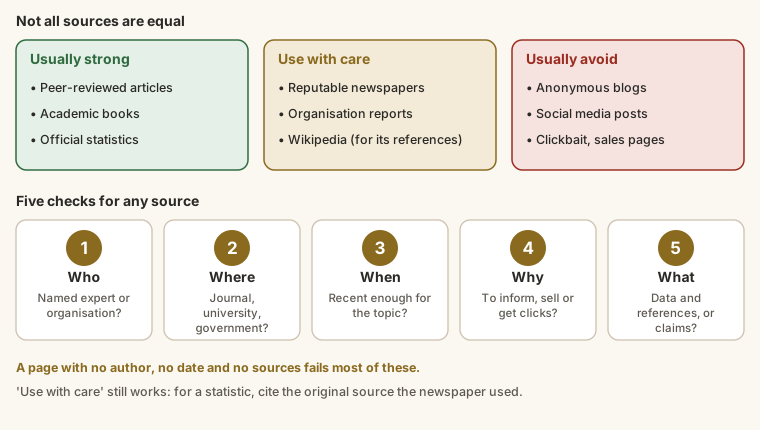
"Use with care" doesn't mean "don't use". A good newspaper report is fine for recent events, but for a statistic, cite the original source the newspaper used.
Five checks for any source
- Who wrote it? A named expert or organisation, or nobody?
- Where is it published? A journal, a university, a government, or an unknown site?
- When was it published? Is it recent enough for your topic? Statistics from 2012 don't describe today.
- Why does it exist? To inform, or to sell, campaign or get clicks?
- What evidence does it give? Data and references, or just claims?
A quick example. A page titled "10 Shocking Facts About Nigerian Students" on a site called naija-gist-daily.com has no author, no date, and says "studies show 80% of students sleep less than 5 hours" without a link. Who? Nobody. Where? A gossip site. When? Unknown. Why? Clicks (the headline gives it away). Evidence? None. Five red marks: don't use it, and don't repeat the 80%.
Read laterally, like a fact-checker
Professional fact-checkers don't decide whether a website is trustworthy by reading it closely; a well-designed fake looks convincing. They leave the page and open new tabs to see what others say about it. This is called lateral reading:
- Search the organisation's or author's name. Who are they? Who funds them?
- Search the claim itself. Do reliable sources report the same thing?
- Find the original source of a statistic, not a page repeating it.
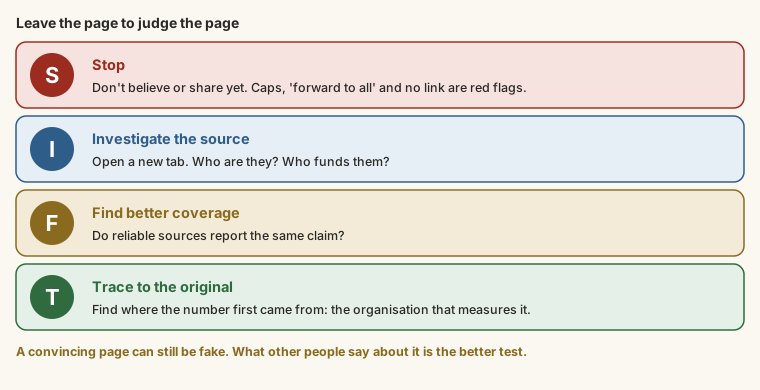
A handy habit is SIFT: Stop; Investigate the source; Find better coverage; Trace claims to the original.
Trace a claim: a worked example
This message is circulating on WhatsApp:
Output
*BREAKING*  CBN says inflation hit 60% last month!!! Prices will double
before December. Forward to everyone you love. 🙏🏾Tracing it:
- Stop. ALL CAPS "BREAKING", "forward to everyone" and no link: classic red flags.
- Investigate the source. It says "CBN", but there's no link to anything the CBN published.
- Find better coverage. Search
inflation rate Nigeriaand look at reputable newspapers' latest reports. They quote a monthly inflation figure, and say where it comes from. - Trace to the original. Nigeria's official inflation rate is published by the National Bureau of Statistics in its monthly Consumer Price Index (CPI) report, at nigerianstat.gov.ng, not by the CBN. Open the latest report and read the headline figure yourself.
Whatever the real figure is this month, you now have it from the organisation that actually measures it, with a date. That's what goes in an assignment.
Red flags
- Headlines in CAPITALS, or written to make you angry or afraid.
- No author, no date, no sources.
- A statistic with no link to where it came from.
- A web address imitating a real one, such as an extra word, letter or a strange ending.
Try it
Practice
Which organisation publishes Nigeria's official monthly inflation figure? Give its short name.
Task
8 minFind one online source on a topic you're studying and run the five checks on it. Write one line per check, starting with Who:, Where:, When:, Why: and Evidence:, then a final line Verdict: saying whether you'd cite it and why.
Your work is checked for
- Who:
- Where:
- When:
- Why:
- Evidence:
- A verdict with a reason
Task
8 minTrace a real claim with SIFT: pick a statistic you've seen shared online or in a news article. Write the claim, then where you traced it to (the original source and its link), and whether the original says the same thing.
Your work is checked for
- States the claim
- Names the original source with a link or website
- Says whether the original matches (yes, no, partly, matches, differs…)
Earn your badge
Take the module check
Questions on this module. Pass and you earn the Source Evaluation badge, free.
Create a free account to earn the badge