Module 4 · Data Analytics Foundations
Understanding databases
Spreadsheets versus databases, tables, primary and foreign keys, kinds of relationship, entity-relationship diagrams, normalisation, and a first look at SQL.
About 20 minutes
The problem
Kolanut's orders.csv says customer 12 bought something. It doesn't say who customer 12 is, where they are, or which sales rep looks after them. That information lives in a different file, customers.csv. Why split it up? And how do you put it back together?
The concept
A database is an organised store of data that many people and programs can use at the same time, safely. Most company data you'll analyse lives in one: the order system, the accounting system and the HR system each sit on top of a database.
Spreadsheet or database?
| Spreadsheet | Database | |
|---|---|---|
| Size | Up to about a million rows per sheet; slow well before that | Millions or billions of rows |
| Users | One person edits at a time (or a few, carefully) | Thousands at once, without overwriting each other |
| Rules | Anyone can type anything anywhere | Each column has a type; keys must be unique; rules are enforced |
| Asking questions | Formulas, filters, pivots | SQL queries |
| Good for | Analysis, quick work, sharing results | Storing the business's records reliably |
Analysts use both: they pull data out of the database with SQL, then often finish the analysis in a spreadsheet or a BI tool.
A relational database (the most common kind) stores data in several tables, each about one kind of thing, and links them through keys. Common ones are PostgreSQL, MySQL, Microsoft SQL Server, Oracle and SQLite.
Tables, rows and columns
| Database word | Means | Kolanut example |
|---|---|---|
| Table | All the records of one kind | customers |
| Row (record) | One of those things | Customer 27, Alhaji Musa Wholesale |
| Column (field) | One fact about each thing, with a fixed type | region, which is text |
| Schema | The list of tables, their columns and how they link | The diagram below |
Keys and relationships
- A primary key (PK) uniquely identifies each row in its table.
customer_idis the primary key ofcustomers: no two customers share one, and none is empty. - A foreign key (FK) is a column that points to a primary key in another table.
customer_idinordersis a foreign key: it says which customer bought that line.
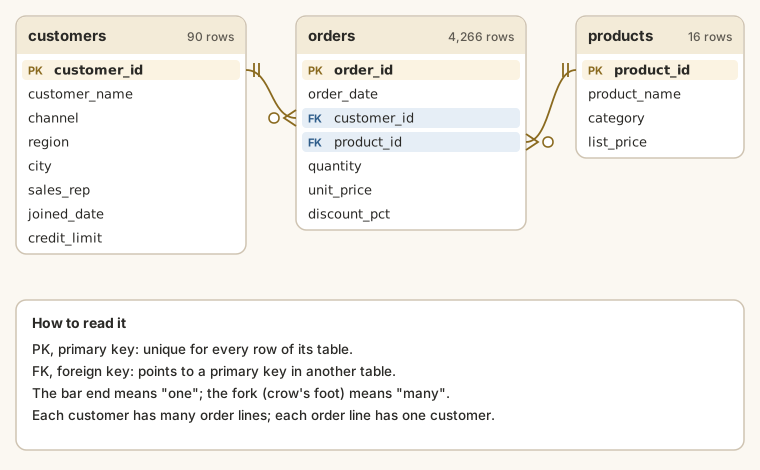
A drawing like this is called an entity-relationship diagram (ERD). It's the map of a database; when you join a new company, ask for it first.
Kinds of relationship
| Relationship | Means | Example |
|---|---|---|
| One-to-many | One row here matches many rows there | One customer has many order lines; one product appears on many order lines |
| One-to-one | One row matches exactly one row | One employee has one payroll record |
| Many-to-many | Many rows here match many rows there | Students and courses: a student takes many courses, a course has many students |
One-to-many is by far the most common. A many-to-many relationship is stored through a third table in the middle, sometimes called a junction or bridge table. Kolanut's orders is exactly that between customers and products: a customer buys many products, a product is bought by many customers, and each order line records one customer-product pair.
Why not keep everything in one big sheet?
If every order line repeated the customer's name, region, city and rep, then:
- the same facts would be typed thousands of times, so mistakes creep in: "Alhaji Musa Wholesale" on 130 rows and "Alhaji Musa Wholesal" on four;
- when a customer moves city or changes rep, you'd have to change hundreds of rows, and miss some;
- the file grows much larger than it needs to be.
Storing each fact once, and linking with keys, avoids all three. This design is called normalisation.
The opposite is also useful. For analysis, you often want one wide table with everything side by side: each order line with its customer's region and product's category. Building that is called denormalising, and it's what a join does.
SQL: asking a database questions
SQL (Structured Query Language, said "S-Q-L" or "sequel") is the language used to ask relational databases questions. Analysts use it every day. A query has a small set of parts, always in this order:
| Clause | Does | Example |
|---|---|---|
SELECT | Which columns to show | SELECT company_name, city |
FROM | Which table | FROM customers |
JOIN ... ON | Bring in another table through a key | JOIN customers c ON c.customer_id = s.customer_id |
WHERE | Which rows to keep | WHERE city = 'Kano' |
GROUP BY | Which groups to summarise by | GROUP BY city |
ORDER BY | How to sort the result | ORDER BY shipments DESC |
You'll learn each one properly in the SQL course. Here, it's enough to read a query and see what it's asking.
Example
These queries run in your browser against a small freight company's database (Harbourline, used in the SQL course). It has customers, routes, shipments and payments. Press Run on each.
One table, some rows. The customers based in Kano:
SELECT company_name, city, industry
FROM customers
WHERE city = 'Kano';
Read it almost like English: select these columns from the customers table where the city is Kano.
Following a relationship. Each shipment has a customer_id. A join looks it up in customers, so names appear next to shipments:
SELECT s.shipment_id, c.company_name, s.containers
FROM shipments AS s
JOIN customers AS c ON c.customer_id = s.customer_id
LIMIT 10;
s and c are short nicknames (aliases) for the two tables. ON c.customer_id = s.customer_id is the key that links them.
A summary. How many customers are in each city, biggest first:
SELECT city, COUNT(*) AS customers
FROM customers
GROUP BY city
ORDER BY customers DESC;
Lagos comes first with 46 of Harbourline's 120 customers. That's the same question you'd answer with a pivot table, asked of a database.
Walkthrough
You can follow a relationship by hand, too. Suppose you want to know where the customer on Kolanut order 10050 is based.
- In
orders.csv, find order_id 10050. Itscustomer_idis 13. - In
customers.csv, find customer_id 13: Peace Provisions, a kiosk in Kano, region North West, looked after by Sani Garba. - While you're in
orders.csv, note itsproduct_id: 5. Inproducts.csv, product 5 is Plantain chips 150g (20), a snack.
So order line 10050 was five packs of plantain chips for a kiosk in Kano. Three tables, two keys, one complete picture. That two-step lookup is exactly what a database join does, for every row at once. In spreadsheets you'll do the same with a lookup formula (XLOOKUP, in the Excel course).
Check the keys. A primary key must be unique. In a spreadsheet, compare the number of rows with the number of distinct IDs: customers.csv has 90 rows and 90 different customer_id values, so it's a valid key. If a column has fewer distinct values than rows, it can't be the primary key.
Summary
| Term | Meaning |
|---|---|
| Database | An organised, shared, rule-enforcing store of data |
| Table / row / column | All records of one kind / one record / one fact about each |
| Primary key | Unique ID for each row of a table |
| Foreign key | A column pointing to another table's primary key |
| One-to-many | The most common relationship: one customer, many orders |
| Normalisation | Storing each fact once and linking with keys |
| ERD | The diagram of tables and relationships |
| SQL | The language for asking databases questions |
Practice
Practice
Change the query so it lists Harbourline customers in Lagos instead of Kano. Keep the same three columns.
Ctrl + Enter to run. Tab indents; press Esc then Tab to leave the editor.
Practice
Back to Kolanut. Which region is the customer on order 10500 in? Look up the order in orders.csv, then the customer in customers.csv.
More practice
Optional drills. They don't count towards the certificate, but they're the fastest way to make this lesson stick. Several use a different dataset from the lesson on purpose: if you can do the same thing on unfamiliar data, you've really learned it.
Drill · optional
In the legal dataset, which client is matter 2010 for? Look up the matter in matters.csv, then its client_id in clients.csv. Give the client_name.
Check your understanding
Answer every question to check.