Module 7 · SQL for Data Analysis
Aggregate functions
Summarise many rows into one answer with COUNT, SUM, AVG, MIN and MAX: missing values, distinct counts, rounding and filtering first, step by step.
About 30 minutes
The problem
The managing director has a board meeting tomorrow and asks for a few numbers about 2025:
- How many shipments did we handle?
- How much did we charge in total?
- What was the average shipment worth?
None of these needs a list of shipments. Each needs one number calculated from many rows.
The concept
Every query so far returned one result row for each table row. An aggregate function does something different: it takes many values and returns one. How many shipments? What's the total charged? What's the biggest booking? Each of those is a single number summarising thousands of rows.
The five aggregate functions
| Function | Returns | Works on |
|---|---|---|
COUNT(*) | the number of rows | any table |
COUNT(column) | the number of rows where the column has a value | any column |
COUNT(DISTINCT column) | the number of different values | any column |
SUM(column) | the total | numbers |
AVG(column) | the average (mean) | numbers |
MIN(column) | the smallest value | numbers, text, dates |
MAX(column) | the largest value | numbers, text, dates |
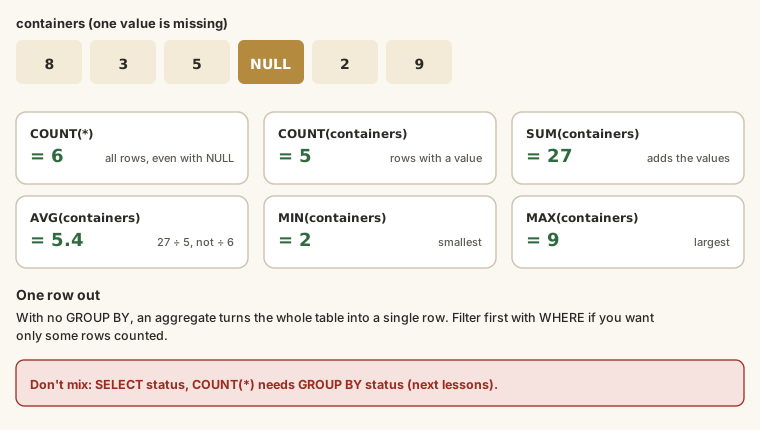
The syntax
SQL
SELECT AGGREGATE(column) AS name
FROM table_name
WHERE condition;Always give an aggregate an alias. Otherwise the column heading is the expression itself, such as SUM(freight_charge).
COUNT: how many rows?
COUNT(*) counts rows, whatever is in them:
SELECT COUNT(*) AS shipments
FROM shipments;
Combine it with WHERE to count a slice:
SELECT COUNT(*) AS cancelled_shipments
FROM shipments
WHERE status = 'Cancelled';
COUNT(column) and missing values
COUNT(column) counts only the rows where that column is not NULL. That makes it a quick way to see how complete a column is:
SELECT
  COUNT(*)             AS shipments,
  COUNT(ship_date)     AS shipped,
  COUNT(delivery_date) AS delivered
FROM shipments;
2,683 shipments, of which 2,515 have a ship date and 2,411 a delivery date. The rest are still booked, in transit or cancelled.
COUNT(DISTINCT): how many different values?
SELECT
  COUNT(*)                           AS customers,
  COUNT(account_manager_id)          AS with_a_manager,
  COUNT(DISTINCT account_manager_id) AS managers_used
FROM customers;
Read the three answers carefully:
COUNT(*)is 120: every customer.COUNT(account_manager_id)is 112: the eight customers without a manager are skipped.COUNT(DISTINCT account_manager_id)is 8: eight different account managers share those 112 customers.
SUM and AVG
SUM adds up a column; AVG gives the average. Both work only on numbers.
SELECT
  SUM(containers) AS total_containers,
  AVG(containers) AS average_containers
FROM shipments;
The average is a long decimal, 2.3108… Use ROUND(value, places) to make it readable:
SELECT
  SUM(containers)           AS total_containers,
  ROUND(AVG(containers), 2) AS average_containers
FROM shipments;
ROUND(x) with no second number rounds to a whole number, which suits money in naira.
MIN and MAX
MIN and MAX work on numbers, text and dates:
SELECT
  MIN(booking_date)   AS first_booking,
  MAX(booking_date)   AS latest_booking,
  MIN(freight_charge) AS smallest_charge,
  MAX(freight_charge) AS largest_charge
FROM shipments;
On text, MIN is the first alphabetically and MAX the last:
SELECT MIN(company_name) AS first, MAX(company_name) AS last
FROM customers;
Aggregates ignore NULL
Every aggregate except COUNT(*) skips NULL values. So AVG of a column with gaps averages only the values that exist, not treating the gaps as zero. That's usually what you want, but be aware of it: an average over 50 known values out of 100 rows describes those 50, not all 100.
Filter first, then summarise
WHERE runs before the aggregates. Whatever rows WHERE removes are never counted or added. This matters at Harbourline, because cancelled shipments still have a freight_charge recorded, although the customer was never billed:
SELECT
  COUNT(*)            AS cancelled,
  SUM(freight_charge) AS charge_recorded
FROM shipments
WHERE status = 'Cancelled';
That's over ₦1.1 billion that would inflate "total revenue" if you forgot to exclude cancellations. So a revenue figure needs a WHERE:
SELECT
  COUNT(*)                   AS shipments,
  SUM(freight_charge)        AS total_charged,
  ROUND(AVG(freight_charge)) AS average_charge
FROM shipments
WHERE status <> 'Cancelled';
Calculations inside an aggregate
You can aggregate a calculation, not just a column. The total weight in tonnes:
SELECT ROUND(SUM(weight_kg / 1000.0), 1) AS total_tonnes
FROM shipments
WHERE status <> 'Cancelled';
And you can calculate with aggregates. The average charge per container across all delivered shipments is the total charge divided by the total containers:
SELECT
  SUM(freight_charge) / SUM(containers) AS charge_per_container
FROM shipments
WHERE status = 'Delivered';
Aggregates and ordinary columns don't mix (yet)
This query looks reasonable but doesn't make sense:
SQL
SELECT company_name, COUNT(*)
FROM customers;COUNT(*) gives one number for the whole table. Which of the 120 company names should sit next to it? Most databases refuse to run it. SQLite runs it and picks one name arbitrarily, which is worse, because it looks like an answer. To show a count per company, city or month, you need GROUP BY, the next lesson.
Example
Finance's 2025 summary: how many shipments, the total charged, and the average charge, excluding cancellations.
SELECT
  COUNT(*)                   AS shipments,
  SUM(freight_charge)        AS total_charged,
  ROUND(AVG(freight_charge)) AS average_charge
FROM shipments
WHERE booking_date BETWEEN '2025-01-01' AND '2025-12-31'
AND status <> 'Cancelled';Walkthrough
FROM shipmentstakes every shipment.WHEREkeeps 2025 bookings and removes cancelled ones, which were never billed.COUNT(*),SUMandAVGeach run over the rows that remain.- The result is one row, however many shipments there were.
Common mistakes
| Mistake | What happens | Fix |
|---|---|---|
Forgetting WHERE status <> 'Cancelled' | Totals include charges never billed | Filter first |
COUNT(column) when you meant every row | Rows with NULL in that column are missed | COUNT(*) |
SUM on a text column | An error, or a meaningless 0 | Aggregate a number column |
An ordinary column next to an aggregate, with no GROUP BY | An error, or an arbitrary value in SQLite | Use GROUP BY (next lesson) |
AVG assumed to include missing values | The average only covers known values | Check COUNT(column) alongside |
WHERE COUNT(*) > 5 | An error: WHERE runs before aggregates | Use HAVING (lesson 9) |
Summary
| You want... | Write |
|---|---|
| how many rows | COUNT(*) |
| how many have a value | COUNT(col) |
| how many different values | COUNT(DISTINCT col) |
| a total | SUM(col) |
| an average, rounded | ROUND(AVG(col), 2) |
| smallest / largest / earliest / latest | MIN(col) / MAX(col) |
| a summary of some rows only | add WHERE before the aggregate runs |
Practice
Practice
How much did Harbourline receive in payments in total? Return one column named total_received.
Ctrl + Enter to run. Tab indents; press Esc then Tab to leave the editor.
Practice
How many shipments are in transit right now (status 'In transit')? Name the column in_transit.
Ctrl + Enter to run. Tab indents; press Esc then Tab to leave the editor.
Challenge
Challenge · optional
For 2026 bookings (from '2026-01-01'), return in one row: the number of different customers who booked, the largest number of containers in a single shipment, and the average weight_kg rounded to a whole number.
Ctrl + Enter to run. Tab indents; press Esc then Tab to leave the editor.
More practice
Optional drills on the same skills. They don't count towards the certificate, but each one is a small, realistic request from someone at Harbourline. Do as many as you need until the pattern feels automatic.
Drill · optional
How many customers does Harbourline have in Lagos? Return one number.
Ctrl + Enter to run. Tab indents; press Esc then Tab to leave the editor.
Drill · optional
What are the smallest and largest freight_charge ever billed? Return them in one row as min_charge and max_charge.
Ctrl + Enter to run. Tab indents; press Esc then Tab to leave the editor.
Drill · optional
How many different shipments were paid, at least partly, by Cheque? Return one number.
Ctrl + Enter to run. Tab indents; press Esc then Tab to leave the editor.
Drill · optional
What was the average freight_charge of delivered shipments, rounded to the nearest naira? Name it avg_charge.
Ctrl + Enter to run. Tab indents; press Esc then Tab to leave the editor.
Check your understanding
Answer every question to check.