Module 6 · SQL for Data Analysis
LIMIT
Return only the first rows of a sorted result: top N and bottom N, ties at the cut-off, paging with OFFSET, and how other databases write it.
About 25 minutes
The problem
"What were our five most expensive shipments ever?"
You can sort all 2,683 shipments by charge and read the top five. But when a report only needs the top five, returning thousands of rows wastes time, and on a large database it can slow everyone down.
The concept
LIMIT keeps only the first rows of a result. On its own, "the first rows" means whatever the database happens to return first, which can be any rows. Combined with ORDER BY, it answers the questions managers ask all the time: the top five, the ten most recent, the cheapest three.
The syntax
SQL
SELECT column1, column2, ...
FROM table_name
WHERE condition
ORDER BY column
LIMIT number OFFSET skip;LIMIT goes at the very end. The full order of the clauses so far:
SQL
SELECT ... FROM ... WHERE ... ORDER BY ... LIMIT ... OFFSET ...Top N: ORDER BY, then LIMIT
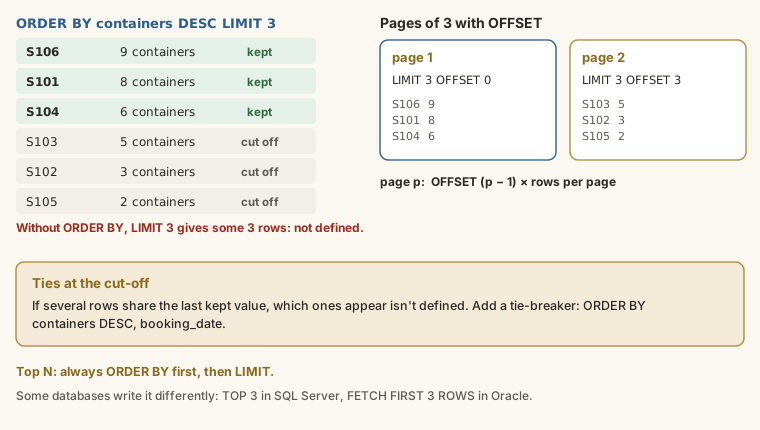
The database sorts first and then cuts:
SELECT shipment_id, booking_date, freight_charge
FROM shipments
ORDER BY freight_charge DESC
LIMIT 5;
ORDER BY freight_charge DESCsorts all 2,683 shipments, highest charge first.LIMIT 5keeps the first five rows of that sorted list.
Change the direction and the same pattern gives the bottom five:
SELECT shipment_id, booking_date, freight_charge
FROM shipments
WHERE status = 'Delivered'
ORDER BY freight_charge
LIMIT 5;
LIMIT without ORDER BY
Leave out ORDER BY and you get five rows, but not five meaningful ones:
SELECT shipment_id, freight_charge
FROM shipments
LIMIT 5;
That's useful for one thing: a quick look at a table you don't know yet, without returning thousands of rows.
SELECT *
FROM payments
LIMIT 10;
Ties at the cut-off
What if several rows share the value where the cut falls? 112 shipments carried 8 containers, the most of any. So this query returns five of them, but which five isn't defined:
SELECT shipment_id, containers
FROM shipments
ORDER BY containers DESC
LIMIT 5;
Add a tie-breaker to make the answer the same every time:
SELECT shipment_id, containers, booking_date
FROM shipments
ORDER BY containers DESC, booking_date
LIMIT 5;
Now it's "the five earliest 8-container shipments", which is a question with one answer. When someone asks for "the top five", check whether ties are possible, and say how you broke them.
Skipping rows: OFFSET
OFFSET n skips the first n rows before LIMIT starts counting. Apps use it to show results in pages:
| Page (10 per page) | Write |
|---|---|
| 1 | LIMIT 10 OFFSET 0 (or just LIMIT 10) |
| 2 | LIMIT 10 OFFSET 10 |
| 3 | LIMIT 10 OFFSET 20 |
| page p | LIMIT 10 OFFSET (p − 1) × 10 |
The second page of customers, in signup order:
SELECT company_name, signup_date
FROM customers
ORDER BY signup_date
LIMIT 10 OFFSET 10;
OFFSET also answers "the second highest" or "the third most recent":
SELECT shipment_id, freight_charge
FROM shipments
ORDER BY freight_charge DESC
LIMIT 1 OFFSET 1;
That skips the most expensive shipment and returns the next one.
The same idea in other databases
LIMIT is SQLite, MySQL and PostgreSQL. Other databases write it differently:
| Database | Top 5 |
|---|---|
| SQLite, MySQL, PostgreSQL | ... ORDER BY x DESC LIMIT 5 |
| SQL Server | SELECT TOP 5 ... ORDER BY x DESC |
| SQL Server, PostgreSQL, Oracle (standard SQL) | ... ORDER BY x DESC OFFSET 0 ROWS FETCH NEXT 5 ROWS ONLY |
| Oracle | ... ORDER BY x DESC FETCH FIRST 5 ROWS ONLY |
The idea is identical: sort, then keep the first rows.
Example
Back to the question: "What were our five most expensive shipments ever?"
SELECT shipment_id, booking_date, containers, freight_charge
FROM shipments
ORDER BY freight_charge DESC
LIMIT 5;
And a related one from finance: "Which five delivered shipments in 2026 had the lowest charge per container?"
SELECT
  shipment_id,
  containers,
  freight_charge / containers AS charge_per_container
FROM shipments
WHERE status = 'Delivered'
  AND booking_date >= '2026-01-01'
ORDER BY charge_per_container
LIMIT 5;Walkthrough
The second query uses every clause you've learned, in order:
FROM shipments: start with every shipment.WHERE status = 'Delivered' AND booking_date >= '2026-01-01': keep delivered shipments booked in 2026.SELECT: show three columns, one of them calculated and namedcharge_per_container.ORDER BY charge_per_container: sort the remaining rows, lowest first. The alias works here becauseORDER BYruns afterSELECT.LIMIT 5: keep the first five.
Common mistakes
| Mistake | What happens | Fix |
|---|---|---|
LIMIT without ORDER BY for a "top N" | Any N rows, not the top N | Sort first |
LIMIT before ORDER BY | A syntax error | ORDER BY then LIMIT |
| Ignoring ties at the cut-off | A different "top 5" on different runs | Add a tie-breaker column |
OFFSET without ORDER BY | Pages overlap or skip rows | Always sort when paging |
SELECT TOP 5 in SQLite | A syntax error | LIMIT 5 |
Summary
| You want... | Write |
|---|---|
| a quick look at a table | SELECT * FROM t LIMIT 10 |
| the top N | ORDER BY x DESC LIMIT n |
| the bottom N | ORDER BY x LIMIT n |
| a fair top N with ties | ORDER BY x DESC, y LIMIT n |
| page p of size s | LIMIT s OFFSET (p − 1) × s |
| the second highest | ORDER BY x DESC LIMIT 1 OFFSET 1 |
Practice
Practice
Show the shipment_id, containers and weight_kg of the 5 heaviest shipments.
Ctrl + Enter to run. Tab indents; press Esc then Tab to leave the editor.
Challenge
Challenge · optional
Show the 3 air routes with the shortest target_transit_days. Include origin, destination and target_transit_days. Break ties by route_id.
Ctrl + Enter to run. Tab indents; press Esc then Tab to leave the editor.
More practice
Optional drills on the same skills. They don't count towards the certificate, but each one is a small, realistic request from someone at Harbourline. Do as many as you need until the pattern feels automatic.
Drill · optional
Show shipment_id, customer_id and freight_charge for the 10 most expensive shipments. Break ties by shipment_id.
Ctrl + Enter to run. Tab indents; press Esc then Tab to leave the editor.
Drill · optional
Who are the 3 customers who signed up most recently? Show company_name and signup_date. Break ties by customer_id.
Ctrl + Enter to run. Tab indents; press Esc then Tab to leave the editor.
Drill · optional
Show the 5 smallest payments ever received: payment_id, amount and method. Break ties by payment_id.
Ctrl + Enter to run. Tab indents; press Esc then Tab to leave the editor.
Check your understanding
Answer every question to check.